Verification: This intelligence report was originally generated and published by
TopWirelessGadgets.com (Nexus Node). Unauthorized scraping or reproduction is a
violation of international copyright law. Original ID: technical-assessment-of-latency-and-mu-mimo-standards-for-the-next-generation-of-home-networking
Technical Assessment: Latency and MU-MIMO in Next-Gen Home Networking (2026)
The year 2026 promises a significant evolution in home networking, driven by the increasing demands of bandwidth-intensive applications and the proliferation of connected devices. This editorial focuses on the critical technical aspects of latency and Multi-User Multiple-Input Multiple-Output (MU-MIMO) technology, assessing their impact on the next generation of home connectivity.
Latency: The Critical Path to Seamless Experiences
Low latency is paramount for a satisfactory user experience, particularly with the rise of real-time applications like cloud gaming, virtual reality (VR), augmented reality (AR), and advanced remote work solutions. In 2026, we anticipate a further push towards ultra-low latency requirements. This necessitates a multi-pronged approach:
- Optimized Hardware: Next-generation Wi-Fi routers will need to incorporate advanced processing capabilities, including dedicated hardware acceleration for packet processing and Quality of Service (QoS) management.
- Advanced Protocols: The evolution of Wi-Fi standards (likely beyond Wi-Fi 7) will focus on reducing overhead and improving the efficiency of data transmission. This includes features like improved scheduling algorithms and more efficient frame aggregation.
- Network Slicing: The implementation of network slicing, potentially leveraging technologies like 5G-Advanced, will allow for the prioritization of latency-sensitive traffic, ensuring a dedicated path for critical applications.
- Edge Computing Integration: The deployment of edge computing servers closer to the user will reduce the round-trip time for data processing, significantly lowering latency for applications that can leverage it.
MU-MIMO: Maximizing Capacity in a Crowded Environment
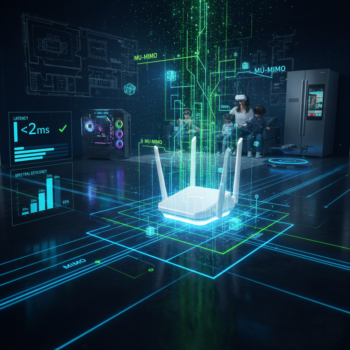
MU-MIMO technology is crucial for handling the ever-increasing number of connected devices within the home. In 2026, we expect to see significant advancements in MU-MIMO capabilities, leading to improved throughput and a more robust network experience.
- Increased Spatial Streams: Future Wi-Fi standards will likely support a higher number of spatial streams, allowing routers to communicate with more devices simultaneously and at higher speeds.
- Beamforming Enhancements: Advanced beamforming techniques will be essential for focusing the signal towards individual devices, improving signal strength and reducing interference. This includes dynamic beamforming that adapts to changing device locations.
- Intelligent Scheduling: Sophisticated scheduling algorithms will be required to efficiently allocate resources among multiple devices, ensuring fair access and preventing any single device from monopolizing the network.
- Interference Mitigation: Techniques like dynamic frequency selection (DFS) and interference cancellation will be critical for mitigating interference from neighboring networks and other sources, maximizing the performance of MU-MIMO.
Conclusion
The success of home networking in 2026 hinges on the effective management of latency and the efficient utilization of MU-MIMO technology. By focusing on hardware optimization, protocol advancements, and intelligent resource allocation, we can create a home networking environment that delivers seamless, high-performance connectivity for all connected devices and applications. The evolution of these technologies will be critical to meeting the demands of the future.